mercredi 23 mars 2011

Lavardin


Agrandir le plan

Shortened history of the castle :

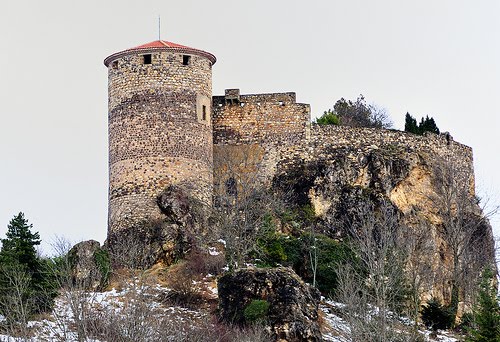
The remains of the Château de Lavardin stand on a rocky promontory, above the village of Lavardin and the Loir.

The first castle, built by Solomon de Lavardin, dates to the beginning of the 11th century, and must have consisted of a wooden keep on a motte, protecting a manor house on the summit of the promontory.

Then, from the 12th to the 15th century, the castle was rebuilt completely, entirely out of stone this time. It was composed of four enclosures surrounding a quadrangular keep, the whole built on three rock platforms excavated in the Middle Ages to increase height.

Of the first enclosure there remains a large gatehouse or "châtelet", with several embrasures for cannons (about 1400).

With a height of 26 meters, the keep dominates the village and the valley.

Opening times and additionnal information :

There is free access to the site. The castle is almost inside the village.

Kyrenia


Agrandir le plan

Shortened history of the castle :

Kyrenia Castle is a spectacular site. The castle dates back to Byzantine times and has served several civilisations : the Byzantines, Crusaders, Venetians, Ottomans, and the British.

Richard the Lion Heart first referred to Kyrenia castle in 1191 when he conquered Cyprus on his way to the crusades.

The castle features huge round towers at its corners that the Venetians built in 1540 to strengthen the castle against artillery.

The view from the castle across Kyrenia harbour is amazing, just what the defending Venetians needed to check for the threatening Ottoman invasion. The irony is, when the Ottoman invasion finally came in 1571, the Venetians gave up without a fight.

Kyrenia Castle also houses the Shipwreck Museum, home to one of the most remarkable marine archaeological treasures in the world. In 300BC, a trading vessel, uploaded with millstones and amphorae (large jars) of wine from Kos and Rhodes set sail for Cyprus. The ship was caught in a storm, and was wrecked outside Kyrenia harbour. The remains of the ship sat on the sea bed covered in sand for 2300 years until 1965, when the remains of what was then the oldest recovered ship in the world began to be recovered. The 47ft long hull is preserved in a specially controlled environment in the Museum, along with wine jars, some utensils used by the crew, and 9000 almonds, which were part of the crew’s rations.

mercredi 16 mars 2011

Busséol


Agrandir le plan

Shortened history of the castle :

The castle was built in 1170 on what was left of a gallo-roman castrum of the 2nd century after the death of J.-C. The name of Busséol comes from the word "buteol" in latin which means "bird of prey", or eyrie in our case. The castle lies at more than 700m in altitude.

The castle kept it's gallo-roman military architectural style which enabled him to successfully resist to the attacks and assaults of Philippe Auguste in 1215, of the Black Prince (Hundred Years War) and of the Duke of La Rochefoucauld (League Wars in 1595).

An extraordinay garden was built in the twelfth century on the top level, atop a the orck on which the castle stands on. It is called the Crusaders' Garden and is invisible from the outside. In this garden you can find a wide range of flowers of Mediterranean origin and it was classified as "Exceptionnal Garden" by the Institute of Parks and Gardens of France.

Opening times and additionnal information :

- 15th of June to 15th of September: from 10am to 12pm and from 2.30pm to 6.30pm
- 16th of september to 14th of June: from 2.30 to 5.30 ONLY on Sundays and Days Off.

The castle is private property.

vendredi 11 mars 2011

La Hunaudaye


Agrandir le plan

Shortened history of the castle:

The castle of La Hunaudaye was built in 1220 by Olivier Tournemine.

The castle is unfortunately destroyed in 1341 during the Successors War in Brittany. At the end of the War the Tournemine Family rebuilds the castle, taking into account the latest military innovations.

At the end of the 15th century, the Tournemine Family was a very important one in Brittany and received in 1487 the title of Barony of La Hunaudaye. But all this power was gained through terror and massacres. One tale even said that the castle was a place no one wanted to approach and that the few who did were never seen again.

The decline of the castle began in the beginning of the 17th century: the Tournemine Family disapears, and lands and estates are sold.

During the French Revolution, the castle was burned and in the 19th century, it is used as a stone quarry. The French State, in emergency, buys it in 1930.

Opening times and additionnal information:

From the 1st of April to mid-June : everyday except saturday from 2.30pm to 6pm
From mid-June to mid-september : everyday from 10.30am to 6.30pm
From mid-September to end of October : everyday except saturday from 2.30pm to 6pm
Open during Easter and Toussaint vacations from 2.30 to 6pm

Ticket prices
adults : 5.00 €
reduced : 3.50 €
children (less than 6 years old) : free

Trécesson


Agrandir le plan

Shortened history of the castle :

The Trécesson family exists since the thirteenth century and some documentary evidence dates the construction of this castle back in the late fourteenth century.

It is much more likely that a previous building has been completely transformed in the fifteenth century, when Trécesson heiress, around 1440, married one of the most famous ducal officers of his generation, Eon de Carne, treasurer and head of the wardrobe of Duke John V.

One of the legends which haunts the castle is the legend of the "Trécesson Bride". In the eighteenth century, a bride would have been buried alive the morning of her wedding. Who were the murderers? Her own brothers! Two boys, disappointed by their sister's future union. Witnessing the scene, a poacher escaped and ran to tell the horror to his wife. She told him: "Go and tell the lord!". Once discovered, the girl was still alive but a few seconds after, her eyes closed forever. Her veil and her bouquet was long exposed to the castle chapel. And the bridegroom, insulted by everyone for not having taken care of his future wife, was sent into the Army.

Additionnal information and opening times :

The castle is private, sometimes open in July and August for visits (3Eur per person)

Tomar


Agrandir le plan

Shortened history of the castle :

The castle of Tomar was built by order of the Temple in 1160, during the Reconquista. Inside the fortress is the Convent of the Order of Christ, which consists of all architectural styles practiced in Portugal between the twelfth and eighteenth century.

The castle of Tomar was built on a strategic location on top of a hill near the river Nabão. It has an outer defensive wall and a pentagonal citadel, also fortified with a tower inside. The keep, a central tower to residential and defensive, was introduced by the Templars in Portugal and that of Tomar is among the oldest in the country.

The fortress was part of the defense system created by the Templars to secure the border of the young Christian kingdom against the Moors, which border the middle of the twelfth century, corresponded roughly to the banks of the River Tagus.

According to Christian chroniclers in 1190, the castle of Tomar resisted for six days to the attacks of the Caliph Abu Yusuf Yaqub Almoravid al-Mansur, who had previously taken other Portuguese fortresses in the South the country. This Christian victory is commemorated by the gate of the fortress, nicknamed "the bloody door."

When the Templar Order was dissolved, castles Almourol and Tomar were given to a new order, the order of Our Lord Jesus Christ, founded March 14, 1319.

Opening times and additionnal information :

From June to September : 9am - 6.30pm
From October to May : 9am - 5.30pm